In today’s urban landscapes, LED street lights have become the backbone of efficient city lighting thanks to their superior energy savings and long lifespan. The integration of intelligent control systems—powered by IoT, AI, and advanced connectivity—has taken this further. By combining remote dimming with proactive fault detection and warning capabilities, these systems deliver a transformative leap in urban illumination. This evolution not only boosts operational efficiency and cuts costs but also enhances public safety and supports sustainability goals, making smart lighting a cornerstone of modern smart city initiatives.
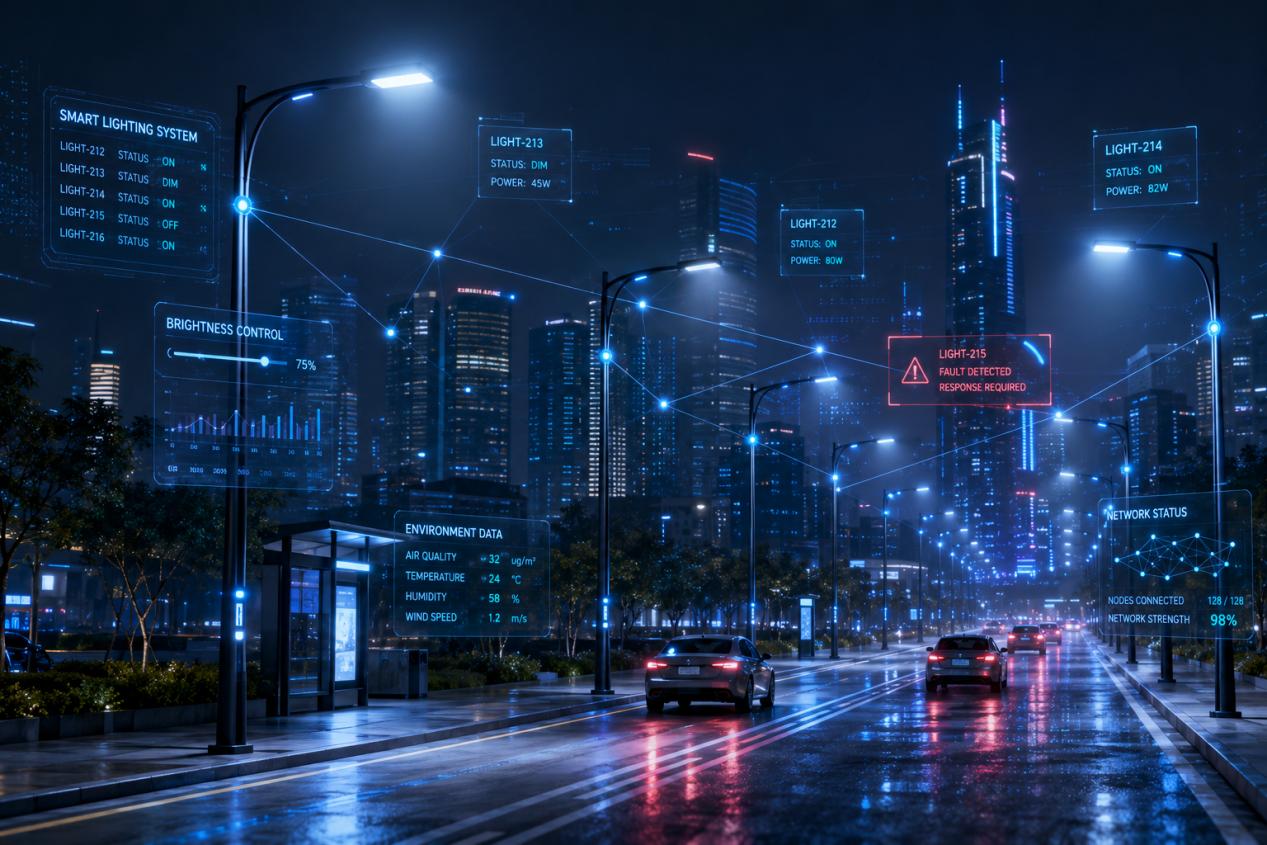
Remote Dimming: Adaptive Lighting for the Modern City
Traditional street lighting relied on rigid on/off schedules, wasting energy during low-traffic periods and lacking responsiveness. Today’s smart control platforms use IoT sensors and real-time data to enable precise remote dimming. City managers can dynamically adjust brightness based on ambient light levels, traffic flow, weather conditions, pedestrian activity, or even AI-predicted patterns.
For instance, lights can automatically dim during late-night lulls to minimize unnecessary consumption or ramp up instantly during fog, heavy rain, or events. Motion or occupancy sensors trigger on-demand illumination in low-traffic zones, while centralized software supports multi-scenario strategies and group controls. These adaptive approaches deliver substantial energy savings—often 25% or more beyond LED efficiencies alone—extend luminaire lifespans by reducing thermal stress, and lower light pollution.
With 5G and edge computing gaining traction, response times are near-instantaneous, enabling seamless integration with broader smart city ecosystems like traffic management.
Fault Warning and Predictive Maintenance: Shifting from Reactive to Proactive
Detecting and addressing failures quickly is critical for safe nighttime operations. Modern smart systems embed continuous monitoring of key parameters such as current, voltage, temperature, power consumption, and LED degradation. When anomalies arise, the platform instantly generates alerts, pinpoints the exact location, and pushes notifications to mobile apps or dashboards.
What sets today’s solutions apart is the move toward AI-driven predictive maintenance. Machine learning models analyze historical and real-time data to forecast potential failures before they occur—such as early signs of driver wear or connection issues—allowing scheduled interventions instead of emergency repairs. This reduces downtime, cuts maintenance costs dramatically (fewer truck rolls and labor hours), and improves overall system reliability.
Seamless Integration: Building a Closed-Loop Smart Ecosystem
The true power emerges when remote dimming and fault intelligence work together in a unified platform. This creates a “sense-analyze-act” loop where data from thousands of lights feeds centralized (or edge-processed) analytics. Managers gain a single-pane view of city-wide performance, optimize dimming schedules using historical insights, and automatically dispatch crews based on predictive alerts.
Smart poles are evolving into multifunctional hubs, often incorporating 5G small cells, environmental sensors, EV chargers, or cameras—turning lighting infrastructure into versatile smart city assets.
Looking Ahead: Lighting the Path to Sustainable Smart Cities
As the connected street lighting market expands rapidly (with strong double-digit CAGRs projected through the 2030s), the fusion of IoT, AI, and 5G is redefining urban lighting. LED street lights are no longer passive fixtures but intelligent nodes that drive energy optimization, public safety, and data-driven governance.
Cities adopting these integrated systems report lower carbon footprints, reduced operational expenses, and improved resident experiences. The future points toward even greater autonomy: AI-orchestrated adaptive grids that anticipate needs, tighter integration with emergency services, and circular designs emphasizing sustainability.
By embracing smart control with remote dimming and predictive fault management, municipalities are not just illuminating streets—they’re building more resilient, efficient, and livable cities for the decades ahead.
 Facebook
 Twitter
 Skype
Skype Email
Email Instagram
 Linkedin
 YouTube
 WhatsApp