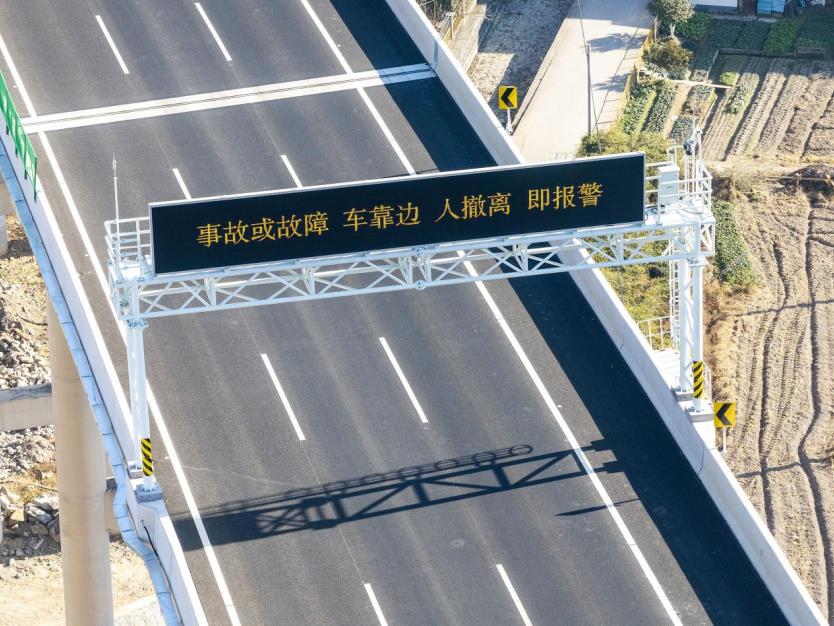
As a primary information dissemination device on highways, the Variable Message Sign (VMS) plays a crucial role in maintaining traffic order and providing drivers with real-time road information. To effectively manage high traffic volumes during extended holidays and ensure smooth traffic flow, a well-designed VMS system must meet the following key requirements:
Operating continuously in harsh outdoor environments, highway VMS are subjected to widely varying ambient light conditions. Beyond ensuring optimal visibility under peak daylight brightness, it is essential to prevent glare and light pollution during low-light conditions such as rainfall, fog, or nighttime. Therefore, a modern VMS must be equipped with intelligent light-sensing technology capable of automatically adjusting brightness according to real-time ambient light levels. This adaptive luminance control is particularly important not only for minimizing glare from high-intensity light sources or secondary reflections but also for enhancing overall visual comfort and safety for drivers under all weather conditions.
Given the extensive geographical deployment of VMS across highway networks, routine manual maintenance and physical inspection present significant logistical and operational challenges. Remote control and automated fault diagnosis functions are thus indispensable for efficient system management. Several years ago, SANSI pioneered the adoption of an integrated intelligent control system, enabling real-time monitoring and early fault detection. This innovation allows traffic management centers to continuously track the operational status of each VMS unit, promptly identify malfunctions, and initiate maintenance procedures—thereby significantly enhancing road safety and system reliability. Additionally, the system features a user-friendly localized human-machine interface, through which maintenance personnel can conveniently access detailed operational status and diagnostic information via an interactive touchscreen, greatly simplifying troubleshooting and repair tasks. Equipped with advanced display drivers and multiple remote communication interfaces for seamless connectivity with central control systems, this intelligent platform has been widely implemented in major highway projects across China.
Looking ahead, with the rapid advancement and deployment of 5G technology, next-generation gantry-style VMS are expected to integrate 5G communication interfaces to support high-speed, low-latency data transmission. This upgrade will significantly extend the range and reliability of information dissemination while enabling more dynamic content management, such as real-time high-definition video feeds and interactive traffic guidance. Furthermore, the integration of IoT sensors and AI-driven analytics could allow future VMS to not only display information but also actively collect and process traffic data, facilitating predictive traffic management and personalized driver notifications. As smart highway ecosystems continue to evolve, the role of such adaptive, interconnected VMS is poised to become increasingly central to intelligent transportation systems—transforming them from passive information displays into active, networked nodes in a comprehensive traffic management framework.
 Facebook
 Twitter
 Skype
Skype Email
Email Instagram
 Linkedin
 YouTube
 WhatsApp